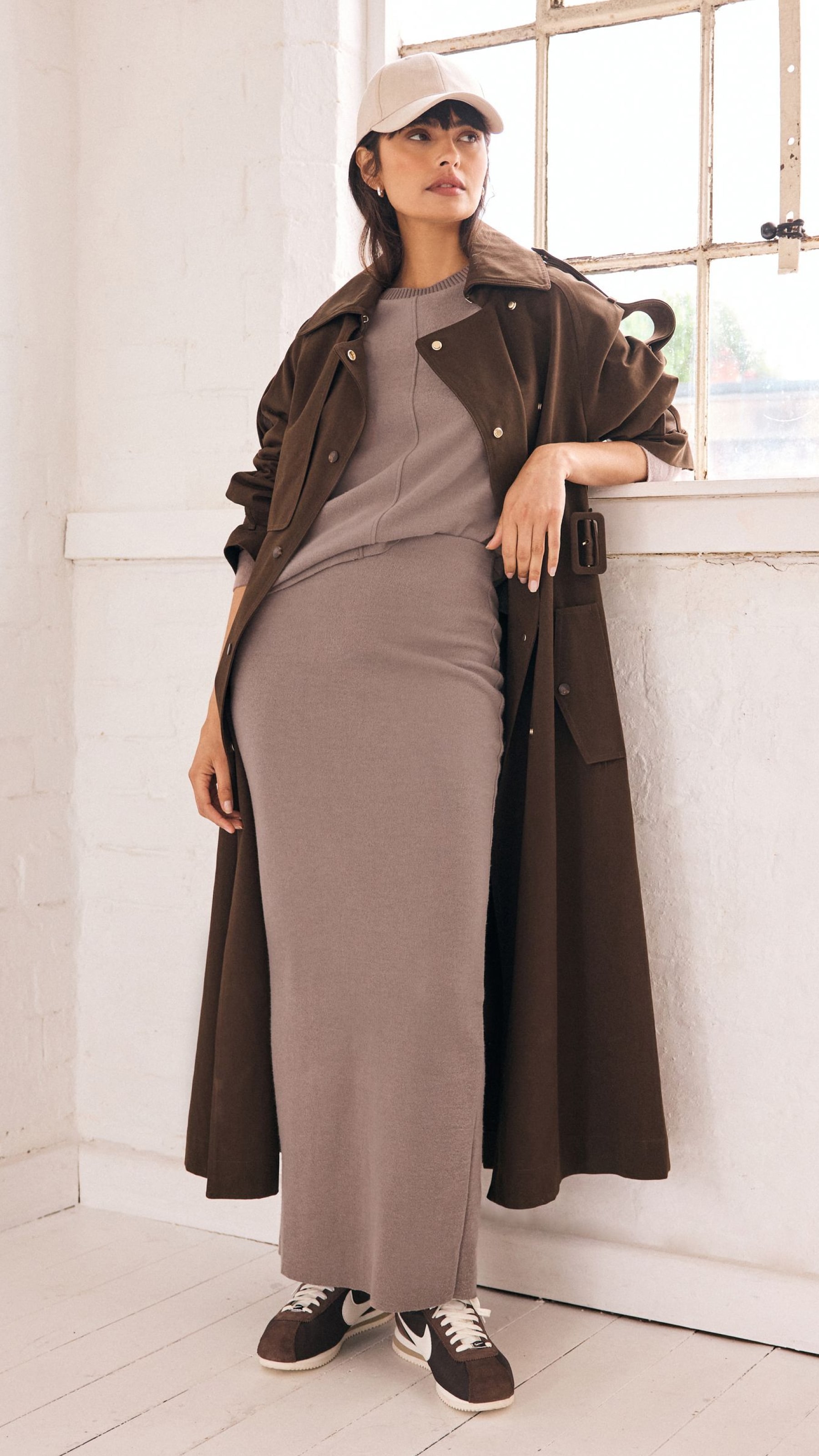

Textile Exchange is a global nonprofit driving beneficial impacts on climate and nature across the fashion, textile and apparel industry. Textile Exchange own the standards, Global Recycled Standard (GRS), Organic Claims Standard (OCS), Recycled Claim Standard (RCS), Responsible Alpaca Standard (RAS), Responsible Down Standard (RDS), Responsible Mohair Standard (RMS), and Responsible Wool Standard (RWS).
NEXT Brand is Brand certified to the Textile Exchange Content Claim Standards (CSS).
The CSS certification verifies that chain of custody principles are followed at each stage of production. This means that documentation is used to track the passage of raw materials from source to final product, addressing the product journey, documentation, volume reconciliations, and segregation of materials and products. Find out more here: textileexchange.org/content-claim-standard/
Each year, NEXT undergoes an audit to maintain our Brand Certification which verifies that all required evidence for product claims has been collected and managed in compliance with the Textile Exchange standards. NEXT is certified by the Certification body USB Certification, and the NEXT Retail certified licence number is USB 006814, and verification of our certified status can be found on: https://textileexchange.org/find-certified-company
.png)
Where a NEXT product is claimed to be made from an organically grown material the Organic Content Standard (OCS) is used to ensure the claim is valid.
Organic cotton, sourced using Organic Content Standard (OCS) is produced and certified to organic agricultural standards, which require practices to sustain ecosystems. Only material from certified organic farms (under one of IFOAM’s Family of Standards) is accepted to the OCS.
Products certified to OCS contain organically grown material that has been independently verified at each stage of the supply chain, from source to final product, using the CSS chain of custody principles.
Find out more: https://textileexchange.org/organic-content-standard/
Unless otherwise stated, where a NEXT product is made from an recycled material the Global Recycled Standard (GRS) or the Recycled Claim Standard (RCS) are used to ensure the claim is valid.
Materials are verified to meet the ISO definition of “recycled.” Both pre-consumer and post-consumer material is accepted.
Products certified to the Global Recycled Standard (GRS) or the Recycled Claim Standard (RCS) contain recycled material that has been (independently) verified at each stage of the supply chain, from the recycler to the final product, using the CSS chain of custody principles.
Where materials are certified to the Global Recycled Standard (GRS), facilities from the recycler to final supplier have met additional social, environmental, and chemical requirements.
Find out more: https://textileexchange.org/recycled-claim-global-recycled-standard/
The RAS, RMS, RWS requires animal welfare and land management practices to be in place at the farm. The Five Freedoms of animal welfare are incorporated into the criteria for the Standards and progressive methods of land management are checked on certified farms to help protect soil health, biodiversity, and native species.
The RAS, RMS, RWS tracks the certified material from farm to final product using the CSS chain of custody principles.
Find out more about RAS, RMS, RWS below:
https://textileexchange.org/responsible-alpaca-standard/
https://textileexchange.org/responsible-mohair-standard/
https://textileexchange.org/responsible-wool-standard/
NEXT is no longer using Mohair in its own Brand products and therefore not using the Responsible Mohair Standard (RMS), but you may see the standard used in other Third Party Brands.
The Responsible Down Standard (RDS) requires animal welfare practices to be in place at duck and goose farms in the down and feather supply chain. Respect for the welfare of birds and geese, from hatching to slaughter, is a core part of the Five Freedoms of animal welfare and is incorporated in the standard criteria. Any removal of down or feathers from live birds (live plucking or molt harvesting) is prohibited in the standard. Force-feeding is also prohibited.
The RDS tracks the certified material from farm to final product using the CSS chain of custody principles.
Find out more: https://textileexchange.org/responsible-down-standard/
.png)
The Better Cotton Initiative (BCI) is a global not-for-profit organisation that supports cotton farming communities in their efforts to improve farming practices, reduce environmental impact, and enhance income and resilience.
NEXT joined BCI in 2017. Each year, NEXT pays a Volume Based Fee (VBF) based on its sourcing of BCI Cotton, which directly contributes to BCI’s Growth and Innovation Fund (GIF).
The foundation of BCI was built on a mass balance chain of custody model. Mass balance is a volume-tracking system that allows BCI Cotton to be substituted or mixed with conventional cotton by traders or spinners along the supply chain while ensuring that the amount of BCI Cotton sold never exceeds the amount of BCI Cotton purchased. For more information about the mass balance system, please visit here.
At NEXT, the reported volume of cotton sourced through the BCI mass balance system is calculated through matching our items and BCI transaction IDs. We also carry out a volume reconciliation check, including our total cotton footprint and the lint volume on the BCI platform.
To read more about BCI, please refer to their website: https://bettercotton.org/
.png)
The U.S. Cotton Trust Protocol (Trust Protocol) provides verified environmental metrics for participating U.S. cotton growers and enables supply chain traceability through digitally recorded transaction data.
The Trust Protocol’s proprietary solution, in partnership with TextileGenesis(™), allows tracking of U.S. Cotton and Protocol Cotton through every stage of production from farms to the finished product. For more information on this process, please visit trustuscotton.org/traceability or textilegenesis.com.
NEXT pays an annual membership fee to the Trust Protocol. For further information on membership benefits and fee structures, please refer to the following page: trustuscotton.org/member-benefits
To read more about Trust Protocol, please refer to their website: https://trustuscotton.org/

REPREVE® is the world’s leading multi-waste source platform, with recycled polyester offerings made from post-consumer plastic bottles and textile waste. All REPREVE polyester is embedded with FiberPrint®, a proprietary tracer that can identify fibers at any point in the supply chain. UNIFI® provides testing to verify the use of REPREVE, granting a U-TRUST® verification to all REPREVE products, to certify recycled content claims.
Only products that have been tested and verified by the REPREVE® team through this process are authorised to display the REPREVE logo.
Find out more: https://repreve.com/
LENZING™ and ECOVERO™ is a trademarks of Lenzing AG
LENZING™ ECOVERO™ fibers are made with at least 50% less carbon emissions and water consumption compared to generic viscose.* More information can be found here.
Lenzing is Dark Green Shirt rated in Canopy’s Hot Button Report indicating that the wood pulp used to make their fibres has a low risk of being sourced from Ancient and Endangered high-carbon biodiverse forests. More information about Canopy can be found here.
LENZING™ ECOVERO™ fibers are produced with a molecular marker. This special identification technology ensures the authenticity and traceability of LENZING™ ECOVERO™ fibers even after processing into textile products. More information can be found here.
NEXT Group Brands procures LENZING™ ECOVERO™ fibres through their suppliers.
*Results based on LCA standards (ISO 14040/44) and available via Higg MSI Version 3.9.1 (December 2024).
TENCEL™ is a trademark of Lenzing AG
TENCEL™ Lyocell and Modal fibers are made with at least 50% less carbon emissions and water consumption compared to generic lyocell and modal* More information on TENCEL™ Lyocell can be found here and for TENCEL™ Modal here.
Lenzing is Dark Green Shirt rated in Canopy’s Hot Button Report indicating that the wood pulp used to make their fibres has a low risk of being sourced from Ancient and Endangered high-carbon biodiverse forests. More information about Canopy can be found here.
TENCEL™ Lyocell and Modal fibers are produced with a molecular marker. This special identification technology ensures the authenticity and traceability of TENCEL™ fibers even after processing into textile products. More information can be found here.
NEXT Group Brands procures TENCEL™ Lyocell and Modal fibres through their suppliers.
*Results based on LCA standards (ISO 14040/44) and available via Higg MSI (Version 3.8).
Livaeco™ is a trademark of Aditya Birla
Aditya Birla is Dark Green Shirt rated in Canopy’s Hot Button Report indicating that the wood pulp used to make their fibres has a low risk of being sourced from Ancient and Endangered high-carbon biodiverse forests. More information about Canopy can be found here.
The production process of Lyocell is a unique closed loop process with 99.7% solvent recovery.
Aditya Birla uses a blockchain technology-based tool (GreenTrack™) that enables the fibre to be traced upwards or downwards along the entire supply chain from source to the finished garment. The fibre contains a unique molecular tracer to enable verification of the fibre in the finished product.
NEXT Group Brands procures Livaeco™ Lyocell fibres through their suppliers
Find out more: LIVAECO™ LYOCELL
Livaeco™ is a trademark of Aditya Birla.
Livaeco™ Viscose and Livaeco™ Modal are fibres made by Aditya Birla from wood pulp that is sourced from certified forests. Aditya Birla is Dark Green Shirt rated in Canopy’s Hot Button Report indicating that the wood pulp used to make their fibres has a low risk of being sourced from Ancient and Endangered high-carbon biodiverse forests. More information about Canopy can be found here.
Livaeco™ Viscose and Livaeco™ Modal are also made in closed loop production plants where water and chemicals are recovered and reused.
Aditya Birla uses a blockchain technology-based tool (GreenTrack™) that enables the fibres to be traced upwards or downwards along the entire supply chain from source to the finished garment. The fibres contain a unique molecular tracer to enable verification of the fibres in the finished product.
NEXT Group Brands procures LIVAECO™ VISCOSE AND LIVAECO™ MODAL fibres through their suppliers
Find out more: LIVAECO™ VISCOSE / LIVAECO™ MODAL
Livaeco™ is a trademark of Aditya Birla.
Livaeco™ viscose with Enhanced Spunshades™ is a branded dope dyed viscose staple fibre from Aditya Birla where colour is added directly to the fibre as it is made, therefore reducing the need for added dyeing methods and giving the fibre increased colourfastness.
Aditya Birla is Green Shirt rated in Canopy’s Hot Button Report indicating that the wood pulp used to make their fibres has a low risk of being sourced from Ancient and Endangered high-carbon biodiverse forests. More information about Canopy can be found here.
Aditya Birla uses a blockchain technology-based tool (GreenTrack™) that enables the fibres to be traced upwards or downwards along the entire supply chain from source to the finished garment.
NEXT Group Brands procures Spunshades Eco-Enhanced Viscose fibres through their suppliers.
Find out more: SPUNSHADES ECO-ENHANCED
Leather Working Group (LWG) is a global, multi-stakeholder initiative comprising brands, retailers, manufacturers, chemical suppliers, and technical experts. It works to promote improved environmental practices within the leather manufacturing industry through the LWG Audit Standards.
LWG-certified suppliers, such as tanneries, are independently audited against the LWG standard, which assesses environmental performance, including traceability and chemical management.
NEXT is a member of Leather Working Group (LWG) and sources leather from LWG-certified tanneries via its suppliers.
Find out more: leatherworkinggroup.com
The Forest Stewardship Council® is an international nongovernmental organisation that promotes environmentally appropriate, socially beneficial and economically viable management of the world’s forests.
When you see the FSC label on products sold by NEXT this means they contain forest-based materials from forests independently audited to Forest Stewardship Council standards, other controlled sources and/or recycled materials.
NEXT is a promotional license holder FSC®-N001602 and sources and sells FSC-certified products. Look for the FSC label on our FSC-certified products. We recognise the FSC system as a suitable way of demonstrating chain of custody and low risk of deforestation through the FSC-certified products and packaging we source.
Find out more here.
Cotton (Organic in conversion) is cotton grown during the 3 year period when a farmer is transitioning from conventional farming to certified organic farming. During year 1 of this multi-year process, synthetic pesticides and fertilisers are eliminated and over 3 years soil health and biodiversity improve before full organic certification is achieved.
Cotton (Organic in conversion) is certified by the Organic Content Standard (OCS), the standard verifies the percentage of Cotton and tracks it from the source to the final product.
Find out more: textileexchange.org
InResST® Recycled Nylon is made 100% from post-consumer fishing nets, collected directly from the fishing boats.
InResST® Recycled Nylon is certified by the Global Recycled Standard (GRS), as well as certifying the waste, the standard verifies the percentage of recycled material and tracks it from the source to the final product.
Find out more: inresst.com
ECONYL® is a trademark of Aquafil S.p.A.
ECONYL® is a recycled nylon fiber made 100% from nylon waste, like fishing nets, carpet flooring, industrial plastic and fabric scraps. Through a regeneration and purification process, the nylon waste is recycled right back to its original purity. That means ECONYL® recycled nylon has exactly the same characteristics as fossil-based nylon, with no difference in quality and performance.
ECONYL® recycled nylon fiber is certified under the Global Recycled Standard (GRS). as well as certifying the waste, the standard verifies the percentage of recycled material and tracks it from the source to the final product.
Tex2Tex® is a trademark of Earth Protex™.
Tex2Tex® is textile-to-textile recycled polyester produced using Earth Protex™’s proprietary Thermo-Mechanical Reactor™ (TMR™) process. Polyester textile waste is collected, sorted, shredded and melted before TMR™ processing, multi-stage filtration and extrusion.
The resulting material can be made into staple fibre, filament, spun yarn, nonwovens, fabrics and garments—returning polyester textile waste to textile applications.
Tex2Tex® products are certified to the Global Recycled Standard (GRS), as well as certifying the waste, the standard verifies the percentage of recycled material and tracks it from the source to the final product.
Find out more: earthprotex.com/tex2tex
LYCRA XTRA LIFE® elastane is a premium stretch fibre used in swimwear, underwear, hosiery and denim to help garments maintain their fit, comfort and appearance. Compared to standard elastane, LYCRA XTRA LIFE® elastane fibres are engineered to provide enhanced durability and resistance to the factors that can cause fibres to break down over time, such as chlorine, suntan cream, body oils and heat in swimwear, laddering in hosiery and shape and performance retention in underwear and denim garments. Performance characteristics are tested by The LYCRA Company in fabric form to ensure the benefit claims are verified.
LYCRA XTRA LIFE® elastane fibre authentication is used to ensure content and chain of custody throughout the supply chain.
COOLMAX® and THERMOLITE® fibres are branded polyester fibres made from 100% post-consumer recycled PET bottles. Performance characteristics are tested by The LYCRA Company in fabric form to ensure the benefit claims are verified.
COOLMAX® and THERMOLITE® fibres are certified to the Global Recycled Standard (GRS), as well as certifying the waste, the standard verifies the percentage of recycled material and tracks it from the source to the final product.
.png)